
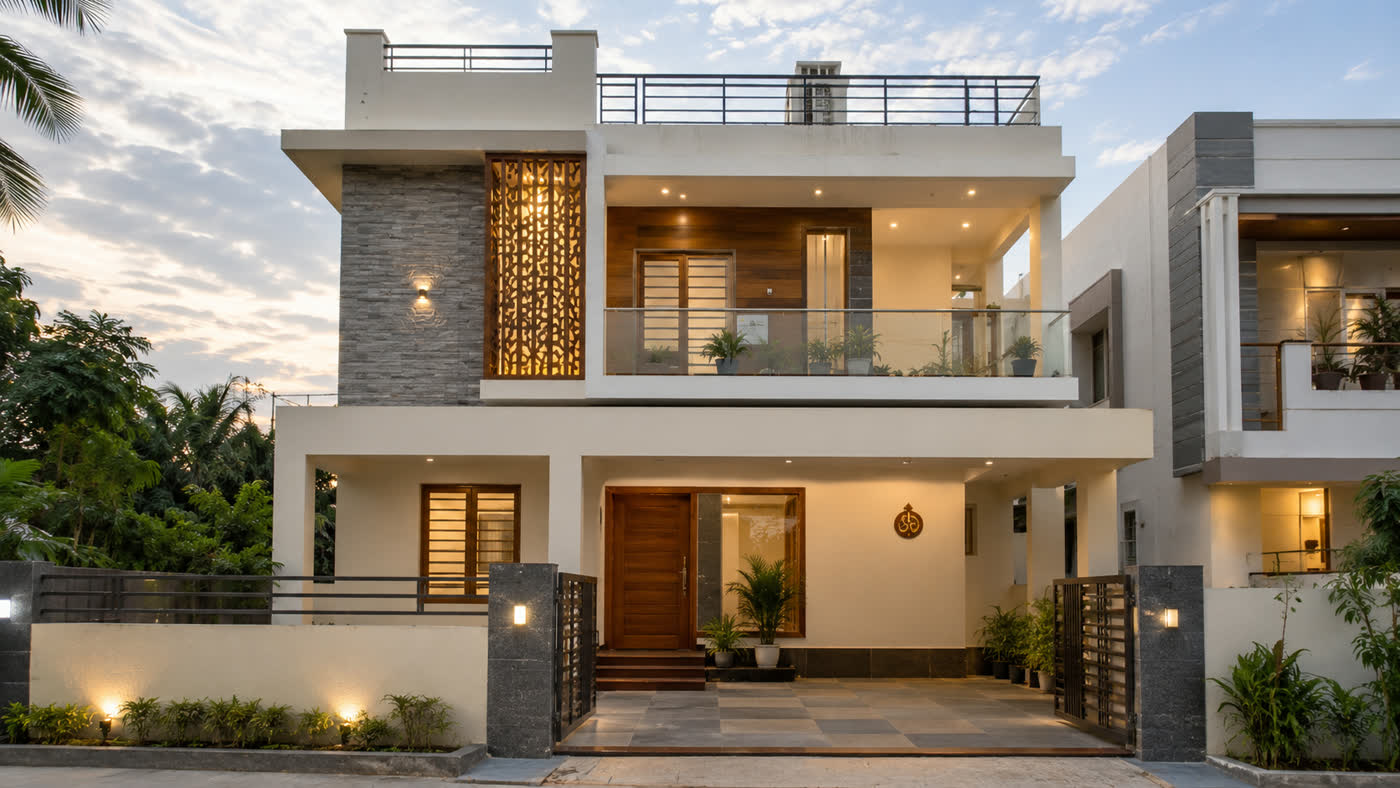
Ask around about building a 3 BHK in Bangalore and you will hear numbers like ₹30 lakh, ₹46 lakh, ₹65 lakh. All for “a 3 BHK”.
Here is the thing nobody explains properly: a 3 BHK is not one size.
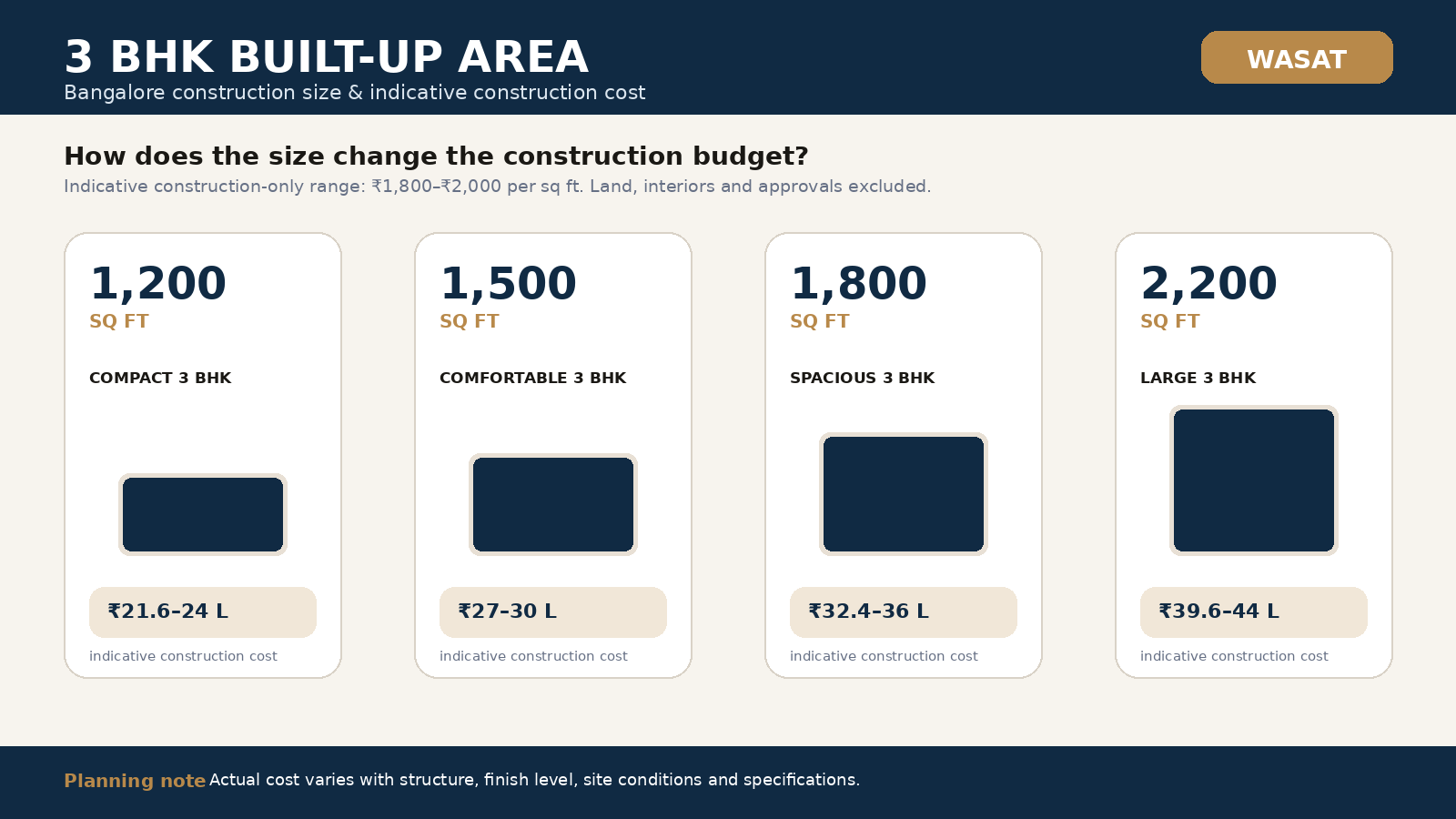
Studies of Bangalore homes put a 3 BHK anywhere between 1,100 and 2,200 sq ft. Both ends have three bedrooms. But one costs roughly double the other.
That is where all the confusion comes from. This guide gives you clear numbers based on the size you actually choose.
The short version
- A 3 BHK in Bangalore costs ₹24 lakh to ₹48 lakh to build, depending on size
- Most 3 BHK homes here are 1,100 to 2,200 sq ft
- Size matters more than rate — it is the biggest single lever on your budget
- Always check whether a price is quoted on carpet, built-up or super built-up area
- Keep aside 20 to 25 percent extra for approvals, connections and utilities
- Building costs rise 6 to 10 percent a year, so waiting has a real price
Quick answer: what does a 3 BHK cost?
At our fixed 2026 rates:
| Built-up area | Economy (₹1,999/sq ft) | Premium (₹2,199/sq ft) |
|---|---|---|
| 1,200 sq ft | ₹23.99 lakh | ₹26.39 lakh |
| 1,500 sq ft | ₹29.98 lakh | ₹32.98 lakh |
| 1,800 sq ft | ₹35.98 lakh | ₹39.58 lakh |
| 2,200 sq ft | ₹43.98 lakh | ₹48.38 lakh |
Construction only. Land, BBMP approval and interiors are extra — all explained below.
Look at the table again. The rate never changes. Only the size changes. That single fact explains why you have been hearing such different numbers.
First, check which “area” someone is quoting
This trips up almost everyone, so please read this before comparing any prices.
There are three different area numbers used in Indian housing, and they are not the same:
Carpet area — the usable floor space inside your walls. What you can actually walk on and put furniture in.
Built-up area — carpet area plus the walls themselves, and usually balconies. This is typically 10 to 15 percent more than carpet area.
Super built-up area — built-up area plus your share of common spaces like lifts, lobbies and corridors. This applies to flats, not to independent houses. It is the largest number, and it is what apartment builders usually advertise.
We quote on built-up area. So does most house construction in Bangalore.
This matters when you compare. If you see a “1,100 sq ft 3 BHK flat” advertised and think your house should cost the same, you are comparing two different measurements. That flat’s carpet area may be closer to 800 sq ft.
Before you compare any two prices, ask which area each one is using.
How big should your 3 BHK be?
This is the real decision, and it drives your budget more than anything else.
Some useful reference points from housing guidance:
- Around 1,110 sq ft of carpet area is commonly cited as the minimum for a functional 3 BHK layout, which works out to roughly 1,330 sq ft of built-up area once walls are counted.
- Anything under 900 sq ft is widely described as very cramped for three bedrooms.
- 1,800 sq ft and above is generally treated as the large or premium end for a 3 BHK.
- For Bangalore specifically, 3 BHK homes commonly fall between 1,100 and 2,200 sq ft.
So the practical range most people choose from is roughly 1,200 to 2,200 sq ft built-up.
What actually changes as you go up: bedroom sizes, whether bathrooms are attached or shared, whether living and dining are one space or two, and whether you can fit extras like a study, pooja room or utility area.
The exact layout depends on your plot shape and frontage. A wide plot allows a different arrangement from a deep, narrow one. This is worth settling with your architect early, because it decides the size you actually need.
Why you see ₹30 lakh and ₹65 lakh for the same thing
When someone says a 3 BHK in Bangalore costs ₹46 to ₹65 lakh, they are usually describing a larger 3 BHK — around 2,000 sq ft or more, often with premium finishes.
When someone says ₹30 lakh, they are usually describing a compact 3 BHK of around 1,200 to 1,500 sq ft.
Neither is wrong. They are describing different houses.
So before you compare any two quotes, ask two questions: how many square feet, and which area measurement? Without both, no price means anything.
Where your money actually goes
It helps to know roughly how a construction budget splits up. Industry figures for Indian home construction put it broadly like this:
| Part of the work | Share of total cost |
|---|---|
| Foundation | 10–15% |
| Structure (RCC frame, walls, slabs) | 25–30% |
| Finishing (flooring, painting, fittings) | 20–35% |
| Materials overall | 50–60% |
| Labour overall | 25–30% |
Two things follow from this.
The structure is not where you save money. Foundation and RCC work together are roughly 40 percent of your budget, and cutting corners there is the one place you should never do it. It is also the part you cannot fix later.
Finishing is where your choices actually show up. This is the most variable part of any build. A useful thumb rule from the industry: every step up in finish quality adds roughly ₹200 to ₹400 per sq ft to your total.
That is worth remembering when you look at our two packages. The gap between Economy and Premium is ₹200 per sq ft — the lower end of that range. On a 1,500 sq ft house, upgrading the entire finish level costs ₹3 lakh.
A simple example
Let us say you want a 1,500 sq ft 3 BHK with the Economy package.
1,500 sq ft × ₹1,999 = ₹29.98 lakh
That is your construction cost.
Now add the other expenses. Keeping aside another 20 to 25 percent for BBMP approval, water and power connections, and small extras gives you roughly ₹36 to ₹37.5 lakh as a realistic total.
That is a budget you can plan around. Not a range from ₹30 lakh to ₹65 lakh.
Single floor or duplex?
You can build a 3 BHK on one floor or across two. This changes how much land you need.
Single floor. The whole house sits on one level, so you need a plot large enough to hold it after leaving the open space required around the building. Easier for elderly parents and small children, with no stairs to climb daily.
Duplex (G+1). The same built-up area split across two floors, so each floor is about half the size — meaning a smaller plot. Bedrooms usually go upstairs, living and kitchen downstairs, which gives natural separation between quiet and busy areas.
A useful fact: the first floor usually costs 10 to 15 percent less per sq ft to build than the ground floor. You are not paying again for the foundation and the plinth — the ground floor already provides that base. This is one reason building upward tends to be more efficient than building outward.
Which is cheaper overall? For the same built-up area, construction cost is broadly similar, with the first-floor saving above working slightly in the duplex’s favour. The bigger difference is land. A duplex needs a smaller plot, and in most parts of Bangalore land costs considerably more per square foot than construction — so a duplex usually works out cheaper overall. But this depends on land prices in your area, so check both before deciding.
If you already own a plot, our 30x40 construction cost guide explains what fits on that size.
One tip: if you may want an extra floor later, tell your engineer before the foundation is designed. Building that strength in now costs far less than trying to add it afterwards.
When should you start?
Two timing factors are worth knowing.
Season. Building through the monsoon can push a budget up by as much as 20 percent through delays, material wastage and higher labour costs. The stretch from October to March is generally the most cost-effective window to start.
Cost inflation. Construction costs in India have been rising roughly 6 to 10 percent a year, driven by cement, steel and labour rates. On a ₹30 lakh build, a year’s delay can add ₹2 to ₹3 lakh for exactly the same house.
This is not a reason to rush a decision you are not ready for. But if you are close to ready, waiting is not free.
Questions to ask every builder
Take this list with you. Ask all six.
- How many square feet are you quoting for?
- Is that carpet, built-up or super built-up area?
- What is your rate per square foot?
- Can I see the material list? Brand of cement, steel, tiles, wiring, fittings.
- What is not included? Ask them to say it plainly.
- Can I get this in writing, item by item?
If a builder gives you one number and cannot break it down, you have nothing to compare. If you are also deciding whether to hire a single builder for the whole job or manage labour and materials yourself, see our turnkey vs labour contract guide.
What is included in our rate
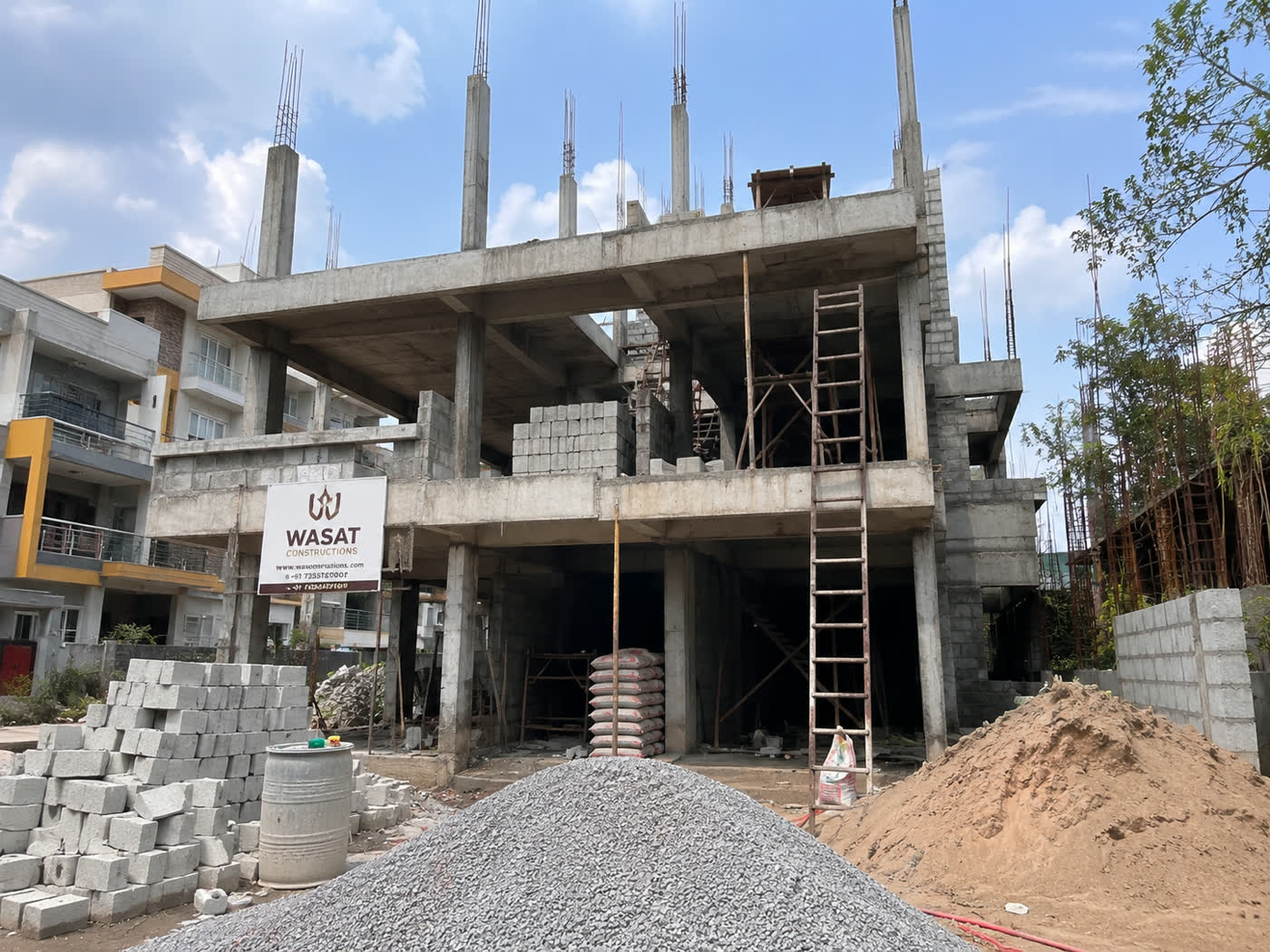
Our package rate covers everything needed to hand over a house you can move into:
- Digging, foundation and RCC structure work
- Brick work, plastering and waterproofing
- Flooring and tiles
- Painting inside and outside
- Full electrical wiring, switches and fittings
- Full plumbing, bathroom fittings and sanitary ware
- Doors and windows
- Site supervision from start to handover
Economy and Premium build the same house. Same structure, same work, same standards. The difference is the quality of materials, fittings and finishing.
What is not included
This is where budgets break. None of these are hidden charges — they are simply separate from the construction rate.
BBMP approval and government fees. Scrutiny fees, betterment charges, development fees and labour cess. Reported figures for Bangalore in 2026 put plan sanction, e-Khata updates and BESCOM and BWSSB deposits together at roughly ₹1.5 lakh to ₹4 lakh, depending on plot size and number of floors.
Borewell, if your site needs one. Commonly reported at ₹1.5 lakh to ₹3 lakh depending on depth.
Soil test. Commonly ₹15,000 to ₹25,000. Never worth skipping — soil conditions decide your foundation design, and getting that wrong costs lakhs.
Interior work — modular kitchen, wardrobes, false ceiling, furniture. Usually another ₹500 to ₹1,500 per sq ft.
Compound wall, gate, sump and overhead tank, unless written into your scope.
Water tankers and temporary power during the build. Over a 12-month project this can add up to around ₹1 lakh.
Architect and structural engineer fees, if hired separately.
Simple rule: keep aside 20 to 25 percent above the construction cost.
BBMP approval
You cannot start building without an approved plan from BBMP.
Approval usually takes 30 to 75 days for a home. Files submitted online with complete documents move faster. Most delays happen because papers are missing or do not match, not because BBMP is slow.
You need e-Khata. Since 1 July 2025, e-Khata is required for the BBMP building licence, plinth certificate and occupancy certificate. Make sure the details match your title deed and property tax receipts. Mismatches here cost people weeks.
Start this early.
Six ways to save money on a 3 BHK
-
Choose the right size first. This is the biggest lever by far. Dropping from 1,800 to 1,500 sq ft saves ₹6 lakh at Economy rates — more than every other saving on this list combined.
-
Keep the shape simple. Every cut, corner and projection costs money without giving you usable space.
-
Decide everything before work starts. Changing your mind after the slab is poured means paying twice. Choosing tiles at the drawing stage costs nothing.
-
Go easy on the elevation. Cladding and decorative external work look nice and add a lot to the bill. A clean elevation looks good for much less.
-
Pick your finish level deliberately. Finishing is the most variable part of any budget, and each step up adds roughly ₹200 to ₹400 per sq ft. Decide this early rather than upgrading piece by piece during the build.
-
Ask for an item-by-item quote. A single lump sum tells you nothing about where you can cut.
How long does it take?
Around 8 to 12 months for a duplex once approvals are in place, assuming payments run on schedule. Add the approval period on top of that, so a realistic end-to-end timeline from first drawing to moving in is closer to 12 to 15 months.
Monsoon months slow excavation and external work, so starting in the drier part of the year usually helps.
Frequently asked questions
How much does it cost to build a 3 BHK house in Bangalore?
At our fixed 2026 rates, a 3 BHK costs ₹23.99 lakh for a 1,200 sq ft home and ₹48.38 lakh for a 2,200 sq ft home with the Premium package. Land, approval fees and interiors are extra.
What size is a 3 BHK house in Bangalore?
Commonly between 1,100 and 2,200 sq ft. Housing guidance puts the functional minimum at around 1,110 sq ft of carpet area, roughly 1,330 sq ft built-up once walls are counted. Homes of 1,800 sq ft and above are generally considered the larger end.
What is the difference between carpet area and built-up area?
Carpet area is usable floor space inside the walls. Built-up area adds the walls and usually balconies, and is typically 10 to 15 percent more. We quote on built-up area.
Is a 3 BHK duplex cheaper than a single-floor 3 BHK?
Construction cost is broadly similar for the same built-up area. The duplex needs a smaller plot, and land is usually the expensive part in Bangalore, so it often works out cheaper overall. Compare land prices in your area before deciding.
What is the difference between Economy and Premium?
The house and the work are the same. Premium uses better quality materials, fittings and finishing.
Does your rate include BBMP approval fees?
No. Government fees are paid to BBMP and are separate from the construction rate.
How long does it take to build a 3 BHK?
Usually 8 to 12 months for a duplex once approvals are in place, plus the approval period beforehand.
Where does the money go in a house build?
Roughly 10 to 15 percent on the foundation, 25 to 30 percent on the structure, and 20 to 35 percent on finishing. Across the whole build, materials account for about 50 to 60 percent and labour about 25 to 30 percent.
Is the first floor cheaper to build than the ground floor?
Yes, usually 10 to 15 percent less per sq ft, because the foundation and plinth are already paid for by the ground floor.
When is the best time to start construction in Bangalore?
October to March is generally the most cost-effective window. Building through the monsoon can raise costs by up to 20 percent through delays and material wastage.
Should I build now or wait?
Construction costs have been rising 6 to 10 percent a year. On a ₹30 lakh build, waiting a year can add ₹2 to ₹3 lakh for the same house.
Want an exact number for your 3 BHK?
The figures here are good for planning. Your final cost depends on your plot, your soil, your area rules and the materials you choose.
Try our cost estimator for a quick figure. Or talk to us and we will give you a proper item-by-item quote based on your drawings.
Wasat Constructions is an ISO 9001:2015 certified construction company in Frazer Town, Bangalore. We build homes, commercial buildings and joint development projects across the city.
Call 888-488-4747 or book a free consultation.